
Fabric options
There are many thousands of options for manufacturing a fabric bag. From standard cotton, Fairtrade organic cotton and recycled cotton to synthetics such as vegan leather, jelly PVC and RPET. This fabric can also be woven, non-woven, knitted or netting. Next there are weights of fabric to consider. If you’re not sure where to start or seen something you like, you can send us a photo and we’ll be able to identify it for you.

Fabric types for custom bags
There are thousands of fabrics available to make your bag. Bag fabric can be woven, non-woven, knitted or netting. Leather, PU leather, jelly PVC or even tarpaulin. Take a look through our catalogue of swatches and if there is something that takes your fancy, we can lend you bag fabric sample to see if it feels like it looks. It’s interesting to note that most fabrics come in numerous weights. Fabric weight is the outcome of how the fabric has been woven, it’s finish and often the fibre type. You’ll see that we have swatches of bag fabric with a short description of what the fabric is and its suitability for a bag style. If you don’t see what you are looking for – do ask us. We will be able to make recommendations.
Fabric weights in GSM and OZ
GSM is a metric measurement meaning grams per square metre- it is how much 1 square metre of fabric weighs and the higher the GSM number the denser the fabric will be. Ounce per square yard (oz/sq2) is the imperial measurement which is also used and what we use at .
A lightweight fabric is typically between 0- 150 GSM, medium weight 150-250 GSM and heavyweight 250-400 GSM,
anything over 400 GSM we consider to be premium weight.
Synthetcis use different grading for weight using the denier classification
If this is all a bit confusing, give us a call! We do this every day and are here to help with choosing your bag fabric, bag style and finishing options.
Check out our Free Fabric weight Converter tool.

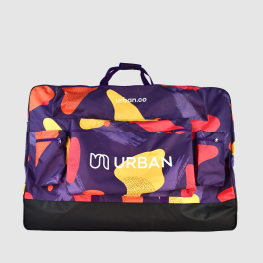
Polyester and nylon fabric weights – understanding denier
Polyester and nylon fabrics are often described using a different measurement called denier, shown as a number followed by a D. You’ll see fabrics referred to as 210D, 420D, 600D or even 1680D. Denier measures the weight of the yarn used to weave the fabric, rather than the weight of the finished fabric. Generally, the higher the number, the heavier the yarn and the more substantial the fabric is likely to be.
For example, 210D nylon or polyester is often used for lightweight bags, linings and drawstring bags. 420D is a popular choice for everyday bags, while 600D polyester is commonly used for backpacks, laptop bags and sports bags where a more durable fabric is needed. Heavier fabrics such as 900D and 1680D are often used for luggage, tool bags and bags that need to withstand more demanding use.
So how does denier compare with GSM or OZ? Well, they measure slightly different things. GSM and OZ tell us the weight of a square metre or square yard of finished fabric, whereas denier measures the weight of the yarn itself. Unfortunately, there isn’t a straightforward conversion between them! A 600D polyester, for example, can have different GSM weights depending on how it has been woven and whether it has a coating or backing. The weave, finish and type of yarn can all make a difference to how the fabric looks, feels and performs.